Roger Bushell – cross-country ski champion
Adam Ruck
Finally got around to reading Paul Brickhill’s account of The Great Escape, after watching the film umpteen times. The book is often described as a novel, which seems odd, since Brickhill was involved in the operation. He assures us in his introduction that the characters – even the most stereotypical German guards with nicknames like Rubberneck and Keen Type – are real, and the story told ‘as nearly the way it happened as I can make it.’
The book’s first paragraph may be the source of the popular misconception that in a previous life the mastermind of this doomed project, Roger Bushell, had been ‘British ski champion’. Wikipedia and many of the Bushell bio-essays that proliferate on the internet repeat this and amplify it with the strangely worded and unreferenced claim that ‘in the early 1930s he was declared the fastest Briton in the male downhill category’ … whatever that means. Declared by whom?
Bushell (b.1910) was indeed a ski racer while at university and for a few years after that, until flying and law work took over in the mid-1930s. He captained Cambridge and helped to organise the Varsity trip when it had to be rescheduled from Switzerland to Canada at short notice as a consequence of the financial crisis which saw sterling break from the gold standard in autumn 1931.
Snow conditions in Quebec were threadbare and no downhill racing was possible. Bushell captained a combined universities team that defeated McGill in a langlauf/slalom match, a victory that was the more surprising because Bushell crashed in the langlauf and cut his face on a ski tip, nearly losing an eye. Paul Brickhill’s description of him ‘swooping downhill like a bat out of hell’ may be journalistic licence. The accident left Bushell with a permanent droop under one eye; Brickhill says the right, others prefer the left. Whatever – it was one or the other, and ‘the effect was strangely sinister and brooding.’
Bushell was not selected for the FIS meeting (later recognised as Alpine skiing’s first World Championship) at Mürren in February 1931 but squeezed into the British team at Innsbruck in 1933 and the following year at St Moritz. He was not among the highest placed British racers in Downhill or Slalom at either event but his 30th place was the best of five British in an unofficial long downhill race at Innsbruck over a 14km course, the lower reaches of which had long flat sections of grass and bare mud.
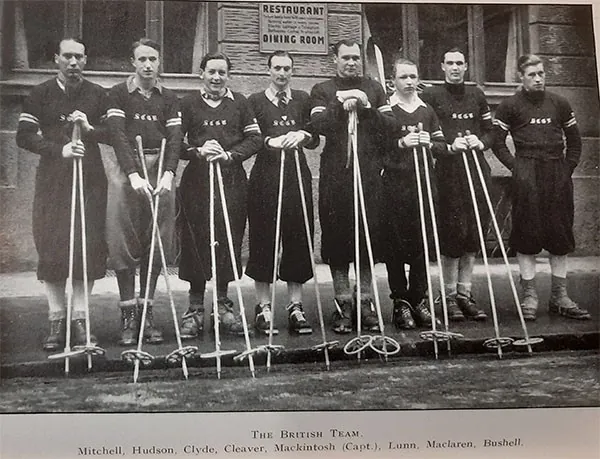
Team GB, Innsbruck 1933. Bushell (extreme right) brooding
However, it was an earlier success that probably gave rise to the ‘British ski champion’ claim. The British Ski Championship meeting at Wengen in January 1931 had opened with a langlauf race for ‘The British Long-Distance Racing Championship’, and Bushell won it. There were only five other competitors and none of the leading downhillers nor the previous year’s winner and outstanding British cross-country skier of the day, HR Spence, were among them.
As for the ski championship proper – the title of ‘British Ski-Running Champion,’ decided on the combined result of the two Alpine races, Downhill and Slalom – Bushell crashed and failed to complete the Downhill and took no part in the Slalom. Bill Bracken won both races and thus took the Championship, over which he had a quasi-monopoly during this period. The meeting also had a ski jumping competition but there was no combined Nordic title for cross-country and jumping, perhaps because only one skier entered both contests.
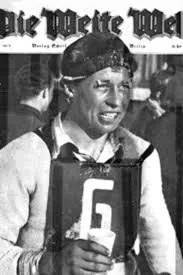
The Swiss ski establishment was slow to come round to downhill racing in the British tradition, remaining attached to the idea that cross-country and jumping were the ski disciplines that mattered. That may account for the acclaim in the local press (pictured) for Bushell’s success in what was effectively a sideshow at the British Championship.
So much for Bushell the skier – a strong and fearless racer, but not the leader of the pack. Brickhill’s book is a terrific story and a great tribute to the skills and ingenuity of the PoWs – the forgers, map makers, costume designers, engineers, diggers and scroungers – and to Bushell’s leadership, however misguided.
One surprising aspect of the book is its failure to mention the successful escape by three prisoners who tunnelled out of the same camp in October 1943, six months before The Great Escape, as told in Eric Williams’s book The Wooden Horse and the film of the same name. Williams and friends used the same ‘trouser-leg’ technique for disposing of sand as the ‘penguins’ described in The Great Escape. Who came up with the idea? Brickhill credits Peter Fanshawe, a key member of Bushell’s team.
We are told that all escaping activity from the camp was centralised and had to be cleared by Big X and his Escape Committee. The Wooden Horse initiative was approved, no doubt with shared intelligence of the trouser-leg sand dispersal ploy.
You’d think the success of the Wooden Horse escape would have had repercussions for those left behind in Stalag Luft III – reprisals as experienced the following year, or at least a stricter regime of vigilance. Presumably the prison authorities took back bearings and worked out how the tunnellers had been getting rid of their sand. If not, does that not suggest that small-scale escapes were in fact a better idea than Roger Bushell’s ambitious mass break-out which had such disastrous consequences?
If only the Germans had discovered the tunnel 12 hours earlier, precious lives would not have been wasted and a great tragedy would have been averted.

